
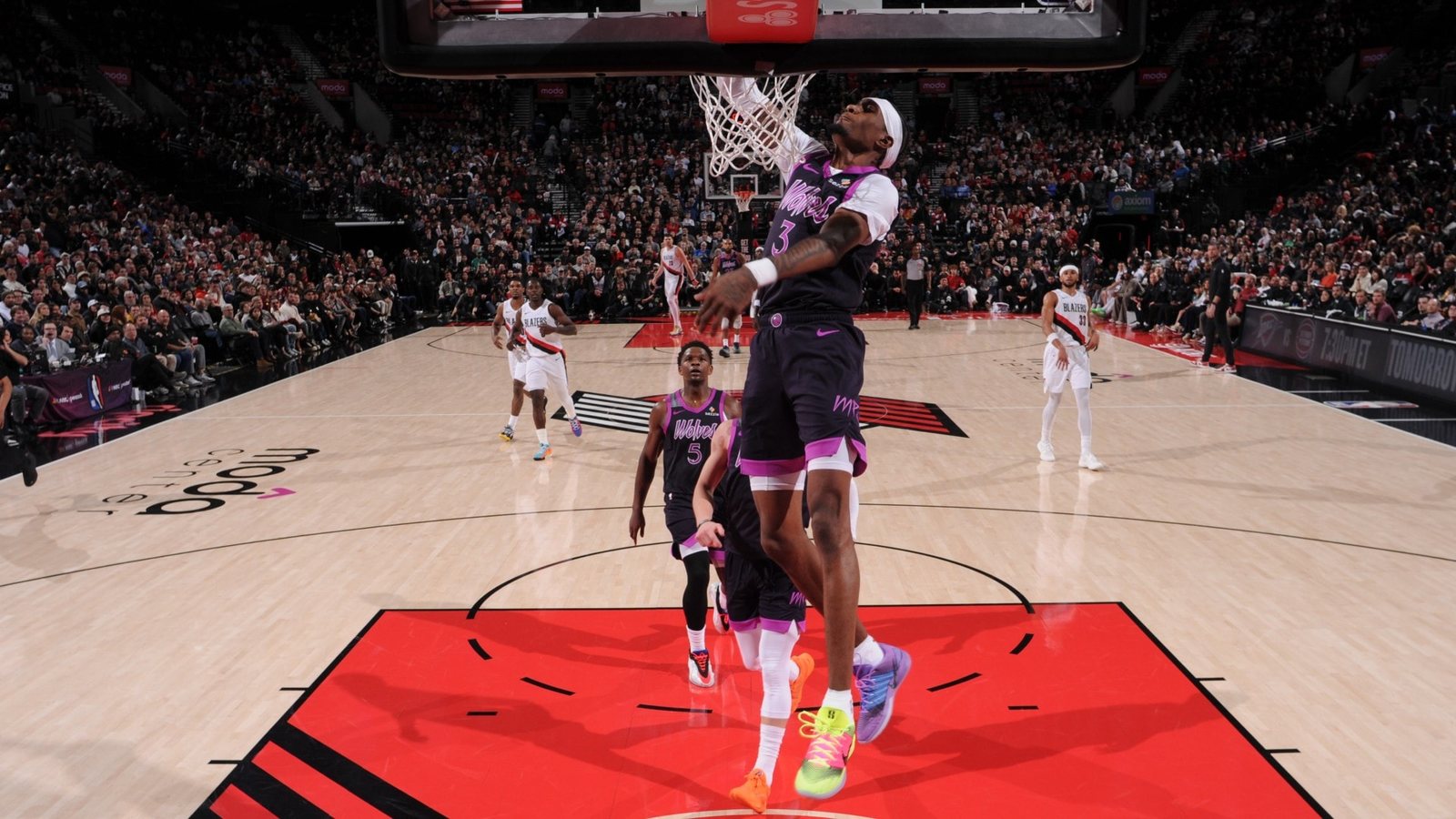
Jaden McDaniels’ stats give the Wolves a reason to demand more than scoring from their power forward. Through Minnesota’s first 11 games, he is averaging 6.1 rebounds, up from 4.2 last season, according to Basketball Reference. I want that work to become a requirement of his role, even as the offense asks more of him.
As of Thursday, November 12, the encouraging part is that the improvement reaches both baskets. McDaniels is collecting more offensive rebounds and more defensive rebounds. Minnesota should keep giving him responsibility for finishing possessions instead of letting a larger scoring assignment become permission to leave the glass to Rudy Gobert.
Jaden McDaniels’ stats show more than extra minutes
Here is the regular-season comparison from Basketball Reference’s McDaniels tables. The current season covers 11 appearances; last season covers 73.
| McDaniels per game | 2025-26 | 2026-27 |
|---|---|---|
| Minutes | 31.7 | 33.8 |
| Offensive rebounds | 1.0 | 1.7 |
| Defensive rebounds | 3.2 | 4.4 |
| Total rebounds | 4.2 | 6.1 |
| Points | 14.8 | 17.0 |
| Assists | 2.7 | 3.6 |
More playing time supplies more chances to collect the ball. It doesn’t explain the entire change here. Basketball Reference’s advanced table puts his offensive rebound percentage at 5.4%, up from 3.7%, and his defensive rebound percentage at 13.5%, up from 10.9%.
Those statistics estimate the share of available rebounds a player collects while on the floor. Both have moved in the right direction. McDaniels is getting more minutes and recovering a larger estimated share of the misses around him.
I would resist turning that into a promise that six rebounds will appear every night. The useful demand is about his assignment. When a shot goes up, I want McDaniels accounting for a rebounder, moving toward an available ball or making a deliberate decision to protect the other basket. He should have a job beyond watching whether the shot falls.
The defensive rebound is part of guarding the possession
Gobert is averaging 12.1 rebounds across 10 appearances, per Basketball Reference’s Wolves page. That gives Minnesota a productive rebounder at center. It should also give the players beside him opportunities to finish the work when he contests a shot.
My preference is for McDaniels to treat the space behind that contest as his responsibility whenever the matchup allows it. Find the opponent trying to slide toward the basket. Make contact before searching for the ball. If Gobert gets the rebound anyway, fine. Keeping a second attacker away still helps the possession end.
This is where I would separate the coaching demand from the individual box score. I would take a possession in which McDaniels keeps his man away and Gobert collects the miss over one in which McDaniels chases the ball and leaves an opponent free. Rebound totals tell us who secured the ball; they don’t identify every useful box-out.
We made the team argument after Minnesota’s defensive rebounding trouble in San Antonio. McDaniels’ season numbers offer an individual standard to carry forward. His improvement is a reason to keep expecting that involvement, rather than treating the Spurs problem as something only the centers must fix.
Keep the offensive pursuit selective
The offensive end calls for a different decision. McDaniels’ 1.7 offensive rebounds per game are welcome, but I would never turn that average into an instruction to crash after every shot. Somebody has to prevent an opponent from turning a miss into a quick attack.
I want him pursuing from positions where he can reach the play without leaving the defense exposed. If he is already near the basket, make the defender finish the box-out. If he is outside and a teammate is attacking the rim, judge whether there is a path to the rebound or whether retreating gives Minnesota more value.
That is a team instruction, too. The guard who sees McDaniels moving toward the basket should know who is covering behind him. Finch can encourage a rebounder without encouraging five players to follow the same miss.
Basketball Reference lists Minnesota’s offensive rebound percentage at 31.8% and its defensive rebound percentage at 73.8%. Those are separate measures at opposite ends of the floor. I want the Wolves to preserve the pursuit at one end while making the recovery at the other dependable. McDaniels belongs in both plans.
More offense should come with the same rebounding demand
McDaniels is averaging 17.0 points and 3.6 assists, up from 14.8 and 2.7 last season, per Basketball Reference. His offensive workload has grown alongside his rebounding. There is no need to choose between those contributions before the schedule forces the question.
Our earlier case for more McDaniels three-point attempts addressed a different part of his job. I still want him willing to shoot an open three. But a missed jumper should lead straight into his next responsibility, whether that is pursuing the rebound or getting back to defend.
The Wolves’ roster and depth chart gives Finch different ways to arrange the frontcourt. My preference in those combinations is to keep McDaniels involved in the rebounding plan rather than automatically handing the work to whichever center shares his shift.
There is a limit to how much responsibility one player can absorb. I would judge his positioning and decisions before demanding another increase in the raw average. Six rebounds collected through sound assignments are more useful than a personal target that pulls him away from the player or space he should protect.
The next step is to make this ordinary. McDaniels has already shown more rebounding alongside more scoring and passing over these 11 games. Keep asking him to finish the possession when the attention moves back to his jumper.