
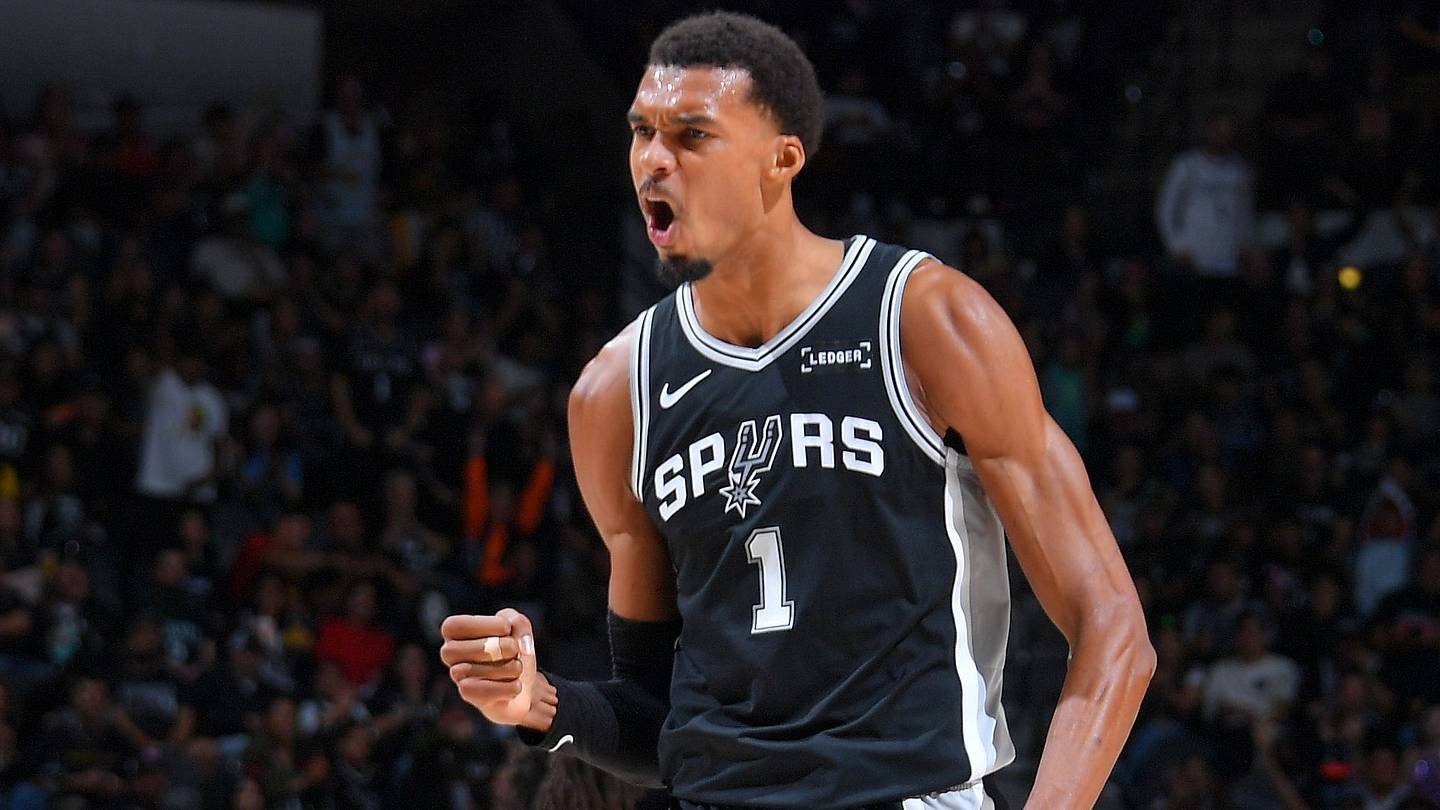
Victor Wembanyama scored 43 points in the Spurs’ 121-111 win over the Timberwolves on Saturday, October 31. The number I would put at the top of Minnesota’s next defensive meeting is 16: San Antonio’s offensive rebounds, according to Basketball Reference. Before Chris Finch changes how the Wolves guard Wembanyama, I want his team to finish the possessions in which the Spurs miss.
That is my priority on Sunday morning. A defensive adjustment should make the whole possession harder for San Antonio. Sending more bodies toward its star won’t accomplish enough if the next shot goes up and nobody keeps the other Spurs away from the rebound.
Wembanyama was only part of the rebounding problem
The Basketball Reference box score credits Wembanyama with three offensive rebounds. Luke Kornet had four and Keldon Johnson had three. San Antonio’s total was 16, which means its leading scorer accounted for fewer than a quarter of its offensive boards.
That distribution is why I would resist making this exclusively a conversation about guarding Wembanyama. Kornet and Johnson combined for seven offensive rebounds, per Basketball Reference. Minnesota needs an answer for the players pursuing the ball around the main matchup, too.
The nearest Wolves player should find a body when the shot leaves a shooter’s hand. If a big has stepped out to contest, someone else has to take responsibility for the space behind him. Watching whether Wembanyama makes a difficult attempt leaves the rest of the possession to chance.
Some misses bounce away from a well-positioned defender. I would still make contact and recovery the starting point of the correction. The Wolves have more control over those jobs than over whether an exceptional scorer makes a contested jumper.
The share of misses recovered makes the problem clearer
Raw rebounding totals depend partly on how many shots miss. Basketball Reference gives San Antonio 16 offensive rebounds and Minnesota 25 defensive rebounds. Divide 16 by the sum of those two figures and the Spurs recovered 39.0% of the rebounds credited to players at their offensive end.
That calculation excludes team rebounds. It measures the division of player rebounds at one end, rather than treating every miss as an identical opportunity. For me, it is still the clearest way to describe how much recovery work Minnesota left unfinished.
At the other basket, Minnesota had 13 offensive boards against San Antonio’s 33 defensive rebounds, per Basketball Reference. The same calculation puts the Wolves at 28.3%. Minnesota did pursue its own misses. San Antonio recovered a larger share at its attacking end.
Our case for shared rebounding after the Orlando win applies here with the direction reversed. I want more than the center taking responsibility. The wing beside a rolling big, the guard nearest a long miss and the player whose assignment is crashing from the perimeter all have a job before Minnesota can begin its next attack.
Beringer’s offensive boards cannot cover the defensive assignment
Joan Beringer finished with six rebounds in 34:28, according to Basketball Reference. Five were offensive and one was defensive. Ayo Dosunmu collected seven defensive rebounds and nine overall in the same box score.
I like Beringer’s pursuit of extra chances on offense. Five recoveries there are useful work. But I want the defensive end to become the first measure of his next extended appearance. After contesting a shot, a center still needs to recover, turn and find the next threat.
That is a broader requirement than simply telling Beringer to grab more rebounds. If he contests away from the basket, I want a teammate covering the available rebounder. If he stays near the rim, I want him establishing position early enough to keep a second Spur from slipping into the play. The assignment changes with the action; responsibility for ending the possession remains.
The case for Beringer as Minnesota’s backup center has focused on staying available without fouling. Saturday adds a separate demand. Productive offensive rebounding should earn him credit, while defensive recovery should determine whether the group around him can get a stop.
ESPN’s AP recap, published early November 1, says Rudy Gobert missed the game with back spasms. His absence is essential context for the center assignment. I would still expect the rest of the Wolves’ roster and depth chart to share the work rather than wait for one player to solve it.
Finish the stop before changing the coverage
Wembanyama made 17 of 34 field-goal attempts, per Basketball Reference. He was a major scoring problem on his own. Even with better rebounding, Minnesota would still need an answer for his scoring.
What it would do is give a successful initial defensive effort a better chance to matter. A contested miss followed by a Spurs recovery asks Minnesota to defend again. A rebound secured by the Wolves lets them choose their next offensive action instead.
The game was close enough for those possessions to deserve attention. ESPN’s quarter scores put Minnesota ahead 61-60 at halftime before the eventual 10-point loss. I don’t see a reason to respond by treating the entire defensive plan as beyond repair.
Finch can change a matchup or send help when a possession calls for it. My demand would remain the same through those changes: identify who takes the shooter, who finds the rebounder and who collects the ball. Wembanyama can make a defense live with difficult baskets. Minnesota should make San Antonio live with its misses.