
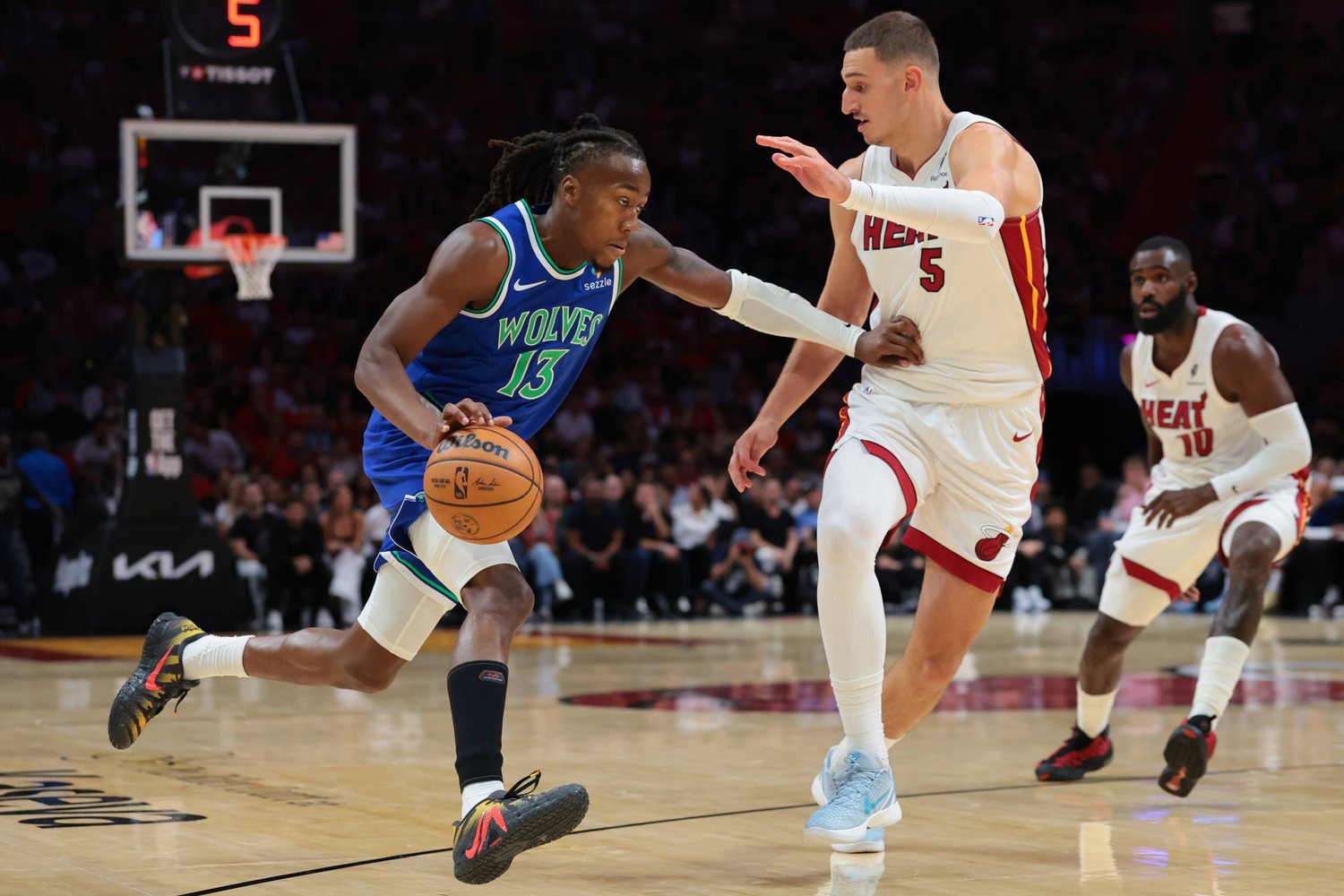
Ayo Dosunmu scored 16 points in the Timberwolves’ 131-106 opening-night win at Miami on Wednesday. The part of his line I want Chris Finch to build on is smaller: three offensive rebounds, according to Basketball Reference. Minnesota should give Dosunmu a regular job chasing misses instead of treating every guard as somebody who has to retreat when a shot goes up.
That would be my next experiment with this offense. Give Dosunmu permission to join the rebounding battle when he has a route to the ball, and assign the other perimeter players to cover behind him. The Wolves can ask more from their guards than shooting and passing. Wednesday’s box score offers a reason to try.
Dosunmu helped make rebounding everybody’s job
The Basketball Reference box score credits Minnesota with 17 offensive rebounds. Rudy Gobert had five and Joan Beringer four. Dosunmu’s three came next, ahead of every other Wolf.
Those centers combined for nine. Everybody else supplied eight: Dosunmu’s three, two from Jaden McDaniels and one apiece from Jonathan Kuminga, Terrence Shannon Jr. and Jaylen Clark. That is nearly half the team’s offensive boards coming from outside its two centers.
I like what that suggests for the assignments around Gobert. He should have help pursuing the ball. Asking him to screen, make himself available near the basket and recover every missed jumper would put too much of the possession on one player. A guard who gets involved gives the defense another rebounder to account for.
Dosunmu also had two defensive rebounds, bringing his total to five, per Basketball Reference. The split is why his night deserves a closer look than the total alone. Three recoveries at the attacking end gave Minnesota opportunities to continue an offense that otherwise might have been finished.
A three-point offense still needs somebody near the rim
Minnesota made 21 of 50 threes, per Basketball Reference. That also means 29 missed threes. Even a successful shooting night leaves plenty of possessions for somebody to rescue.
The box score doesn’t tell us which of Dosunmu’s rebounds followed threes, and I wouldn’t credit him with recovering a particular teammate’s miss from those totals. What it does show is a team willing to shoot from outside and a guard contributing on the offensive glass in the same game. I want those responsibilities to coexist.
Our piece on Anthony Edwards’ opening-night three-point volume makes the case for trusting his jumper. This is a separate demand on the players around the shot. When Edwards releases the ball, somebody should already be deciding whether there is a realistic chance to keep the possession alive.
My preference is for Dosunmu to make that read when he’s already moving toward the basket or standing close enough to challenge for a rebound. I would not send him running in from any location just to meet a target. A useful assignment starts with where the player is when the shot goes up.
That also preserves his value as a scorer. Dosunmu made six of 13 field-goal attempts, including one of three threes, and all three of his free throws, per Basketball Reference. I want him available for a pass and ready to shoot before I want him hunting a rebound. The second job begins when the first shot is taken.
Judge the chances they recover, not just the raw total
Seventeen offensive boards sounds enormous. There were also plenty of misses to pursue: Minnesota made 46 of 98 field-goal attempts, per Basketball Reference. A raw rebounding total needs that context.
A useful box-score calculation is Minnesota’s 17 offensive rebounds divided by those 17 plus Miami’s 30 defensive rebounds. That comes to 36.2%. It measures Minnesota’s share of the rebounds credited to players at that end, rather than assuming every missed shot produced a rebound somebody could collect.
I would track that share alongside the total. If Minnesota shoots better and records fewer offensive boards, it may simply have fewer chances. If the Wolves keep recovering a healthy share of the available rebounds, the assignment is still doing its work.
There is a good reason to care about the players beyond Gobert here. Our analysis of the production Minnesota lost with Naz Reid and Julius Randle raised the rebounding question before the opener. Dosunmu provides one possible contribution from a different position. The full Wolves roster and depth chart shows how the guards and bigs have to fit together.
Give the permission a limit
The cost I would watch is the defense after a miss. If Dosunmu goes after a rebound, Finch needs somebody else responsible for getting back and finding the ball. Sending an extra player toward the rim without that agreement would be a poor trade.
I would keep the rule simple. Attack a rebound when the route is there. Retreat when an opponent has already secured the inside position and the chance is gone. The other guards should know which teammate has permission to go, rather than discovering it as Miami or the next opponent starts running.
Three offensive rebounds should not become Dosunmu’s nightly quota. They should earn him a clear assignment and a chance to show he can repeat the decisions that produce extra possessions. When the next Wolves jumper misses, I want Dosunmu reading the rebound before he automatically turns toward the other basket.