
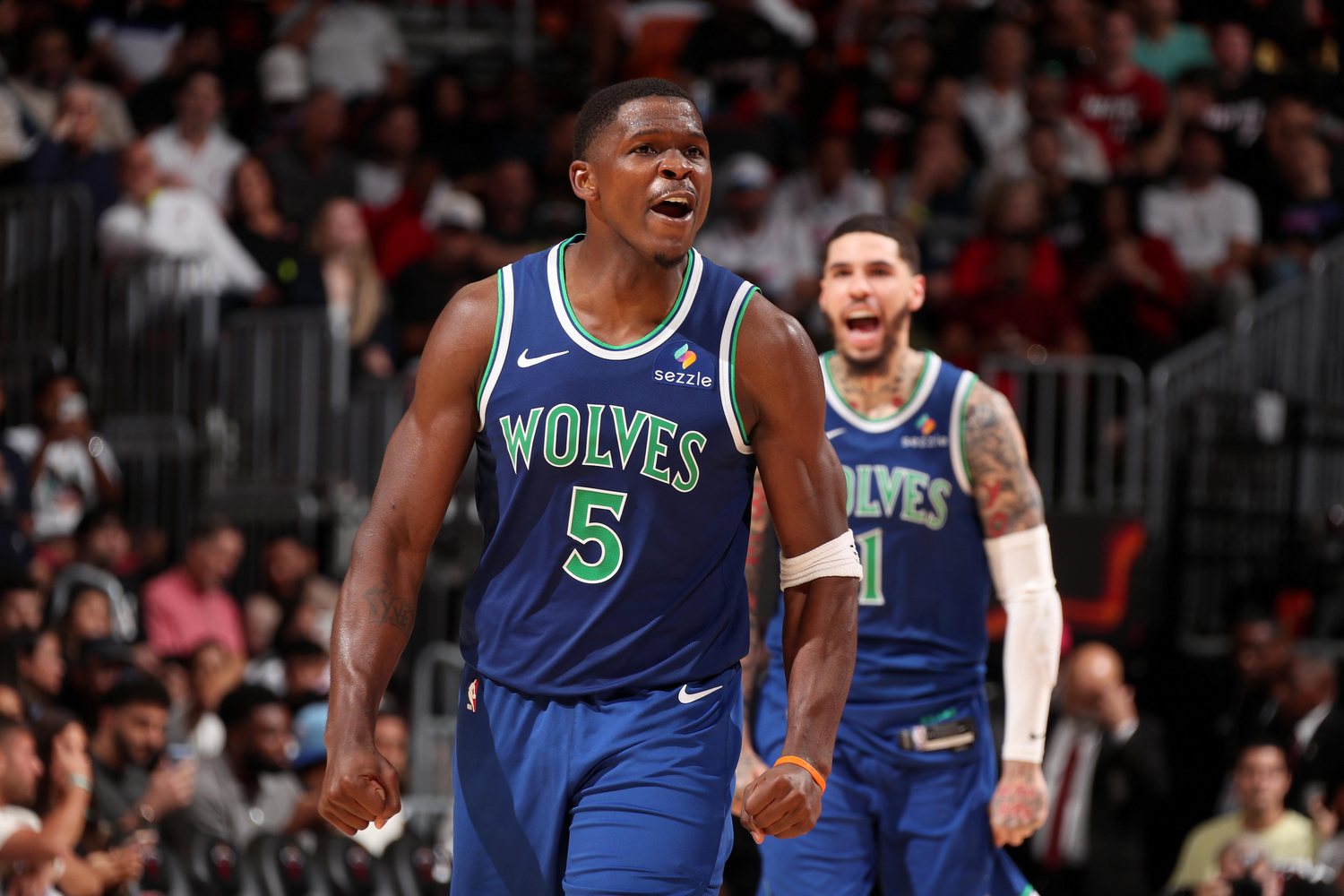
Anthony Edwards scored 45 points as the Timberwolves opened their season with a 131-106 win at Miami on Wednesday. Nine made threes will get the attention. The 17 attempts are what I want Chris Finch to remember.
I want Minnesota to keep feeding that shot. Edwards does not have to make nine every night for a heavy dose of threes to make sense. The first game gave the Wolves a spectacular result, and it also gave them a useful question for the less spectacular nights: will they trust the same offense when a few more of those shots miss?
Edwards did damage from both sides of the arc
Per ESPN’s box score, Edwards shot 16-for-29 overall, 9-for-17 from three and 4-for-5 at the line. Subtract the threes and he made seven of 12 two-point attempts. That is the part I like alongside the volume. He could take a lot of threes and still score efficiently inside the arc.
This is the standard I would use when judging his shot selection. Getting downhill should remain a threat. It should not become a rule that he has to pass up a three to prove he is attacking. On Wednesday, the two kinds of offense fit in the same scoring line.
The threes supplied 27 of his 45 points. That leaves 18 from twos and free throws. Even on a night defined by his jumper, Edwards had another way to score. I would rather give a scorer with that range permission to shoot than ask him to meet an arbitrary limit on perimeter attempts.
Seventeen is a big number. I would not make it a nightly target. A possession should still end with the best available look, and sometimes that will belong to somebody else. But if defenses keep giving Edwards shots he and Finch want, the number of previous attempts should not be a reason to turn the next one down.
Ball made the perimeter bet bigger
LaMelo Ball added 21 points on 7-for-17 shooting, including five of 13 from three, with six assists, per ESPN. Together, the guards made 14 of 30 threes. Minnesota finished 21-for-50.
That is a lot of the offense in two players’ hands. It is also why I remain on the side of playing Edwards and Ball together. I want a defense to have to account for both shooters on the same possession. The threat of a pass becomes more valuable when the player receiving it can punish the defense immediately.
Both guards could take a large number of threes in the same game and still have productive scoring nights. That is the version of this partnership I want Finch to encourage: room for each to fire away without asking the other to spend the evening watching. Ball’s own shooting belongs in the plan alongside his passing.
The Associated Press recap, carried by ESPN, identifies the stretch that put Minnesota in control. A 23-7 run across the second and third quarters turned a one-point lead into a 78-61 advantage. Edwards and Ball supplied 17 points in that run. Their scoring arrived together when the game was still competitive.
The other Wolves had room to contribute
The two guards combined for 46 field-goal attempts out of Minnesota’s 98, per ESPN. That left 52 attempts for everybody else. A big night from the stars did not consume the whole shot budget.
Jaden McDaniels scored 17 on 8-for-11 shooting. Jonathan Kuminga had 12 on 5-for-10, including two of four from three. Ayo Dosunmu scored 16 on 6-for-13. Those are encouraging supporting lines because an offense built around Edwards still needs teammates to finish possessions.
For the roles around the guards, the full Timberwolves roster and depth chart is the starting point. My preference is to judge those players by what they do with the openings they get, rather than insist that everyone needs an equal share of attempts.
I also do not want McDaniels’ efficient night to become an argument for keeping him quiet on the perimeter. He took three threes and made one. The case for McDaniels taking more threes alongside Ball survives a game in which Edwards did most of the damage. The next defense might send more attention toward the guards. I want McDaniels ready to shoot when it does.
The shooting margin needs some perspective
Minnesota scored 63 points from three to Miami’s 24, a 39-point advantage, per the ESPN feed. The final margin was 25. Miami made eight of 33 threes while the Wolves made 21 of 50. Nobody should build a season forecast around repeating that gap.
There was work behind the shooting, too. Minnesota collected 17 offensive rebounds to Miami’s four and won the overall rebounding count 52-34, per ESPN. Rudy Gobert had 15 rebounds and Edwards had 10. The Wolves’ willingness to shoot needs that willingness to chase possessions.
The free throws left plenty to clean up: Minnesota made 18 of 29. A cold shooting night would make those missed points much harder to overlook. I want the next close game to be decided with fewer points left at the line.
That is the demand after a win like this. Keep the ambition on offense, improve the possessions around it, and resist treating every miss as a referendum on the plan. When Edwards’ first few threes rim out, I still want Finch giving him the next good one.