
Chris Finch has been asked a version of the same question since LaMelo Ball arrived: do the Wolves stagger their two stars? His answer, on October 9, was “My gut tells me I want them to be out there together.” He added, “we might just double down, play those guys together,” and said the team will be “ready to read it as we go along.”
I think the gut is right, and the stat sheet is why. Most of the threes both players make come off a teammate’s pass. That means they can trade jobs possession to possession, and it is the best argument for never splitting them up.
Both guards already shoot off a pass
Start with Edwards. In 2025-26 he played 61 games, scored 28.8 points a night and made 39.9% of his threes on 8.4 attempts, per Basketball Reference. Of those made threes, 56.1% were assisted. The year before it was 47.5%. His twos tell the other half: only 30.2% of them were assisted, so a big share of his twos were Edwards making something out of nothing.
Now Ball. In Charlotte he took 10.3 threes a game at 36.8%, and threes were 59.5% of his shot attempts. Of his made threes, 62.1% were assisted, per Basketball Reference. Assisted is not the same as catch-and-shoot, and Ball makes most of his threes off someone else’s pass.
Put those together. I expect Edwards to get more open threes when Ball runs the offense. When Edwards has the ball and the defense collapses on him, it has to leave a 36.8% three-point shooter (Ball’s Charlotte number) standing somewhere.
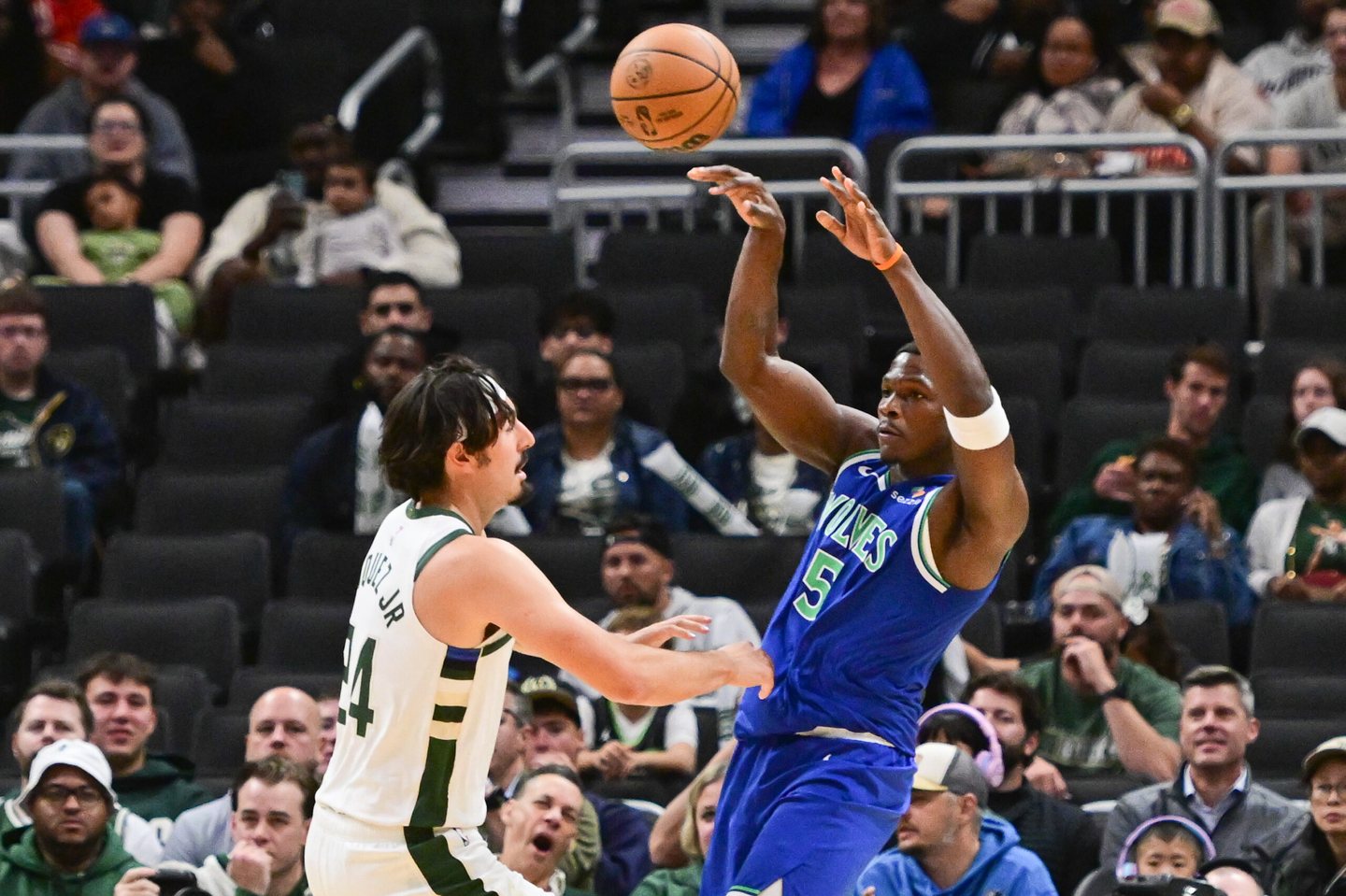
What Finch saw against the Knicks
The day after the 122-104 win at Madison Square Garden on October 12, Finch repeated that instinct, per a post from reporter Jon Krawczynski: he wants his two guards sharing the court a lot. “If you look at the shots that Ant was able to make last night, they were all super easy,” Finch said. “A lot of them were generated through LaMelo’s playmaking.”
The box score backs him. Edwards went 8-of-16 for 26 points in 25 minutes, per Yardbarker and Yahoo Sports. Ball took only seven shots, made three, and finished with seven assists. I went through the rest of that game, including Ball’s five turnovers, in my piece on Finch’s “moodiness for giddiness” line.
One preseason game against a Knicks team that had lost its first three settles nothing.
Why not stagger them
The usual case for staggering is simple: keep one creator on the floor at all times. Last season Edwards averaged 3.7 assists and 2.9 turnovers in 35.0 minutes a night.
If Ball plays 28 minutes the way he did in Charlotte (28.0 a game), and Edwards plays 35, they overlap for most of Ball’s night regardless. The question is whether Finch cuts that overlap on purpose. I would not. When they share the floor, the Wolves have two players the defense cannot ignore, a center in Rudy Gobert who can again be a lob threat, and a wing in Jaden McDaniels who should take more threes with Ball around. Splitting the two guards gives up all of that to guard against a stagnant possession.
The rim is the other reason
Edwards took 18.0% of his shots from within three feet last season and made 75.6% of them, including 48 dunks, per Basketball Reference. He also took 7.2 free throws a game. Those are the shots a second passer can multiply: a defense that has to guard Ball’s 10.3 threes a game cannot pack the paint, and the lanes Edwards attacks stay open. Ball’s own twos were assisted only 25.2% of the time in Charlotte, so he creates his inside shots himself. Each guard gets his preferred shot without the other having to give one up.
The cost is the bench
Playing the stars together means somebody else carries the minutes when one sits. Finch said “the TJ (Shannon)/Ayo combos are really, really good,” and with Donte DiVincenzo still working back from a torn Achilles, that duo is much of the margin. Our 2026-27 roster and depth chart has the order. Finch said they’ll be “ready to read it as we go along,” and the bench minutes are where that reading will show.
What to watch
The season opens Wednesday, October 21 at Miami. Three numbers will tell us whether Finch’s gut holds up: Ball’s turnovers when he shares the floor with Edwards, Edwards’ free throw attempts (he took 7.2 a game last season) with a second creator next to him, and how many of his threes are assisted. If that last one climbs past last year’s 56%, the pairing is doing what Finch says it will.