
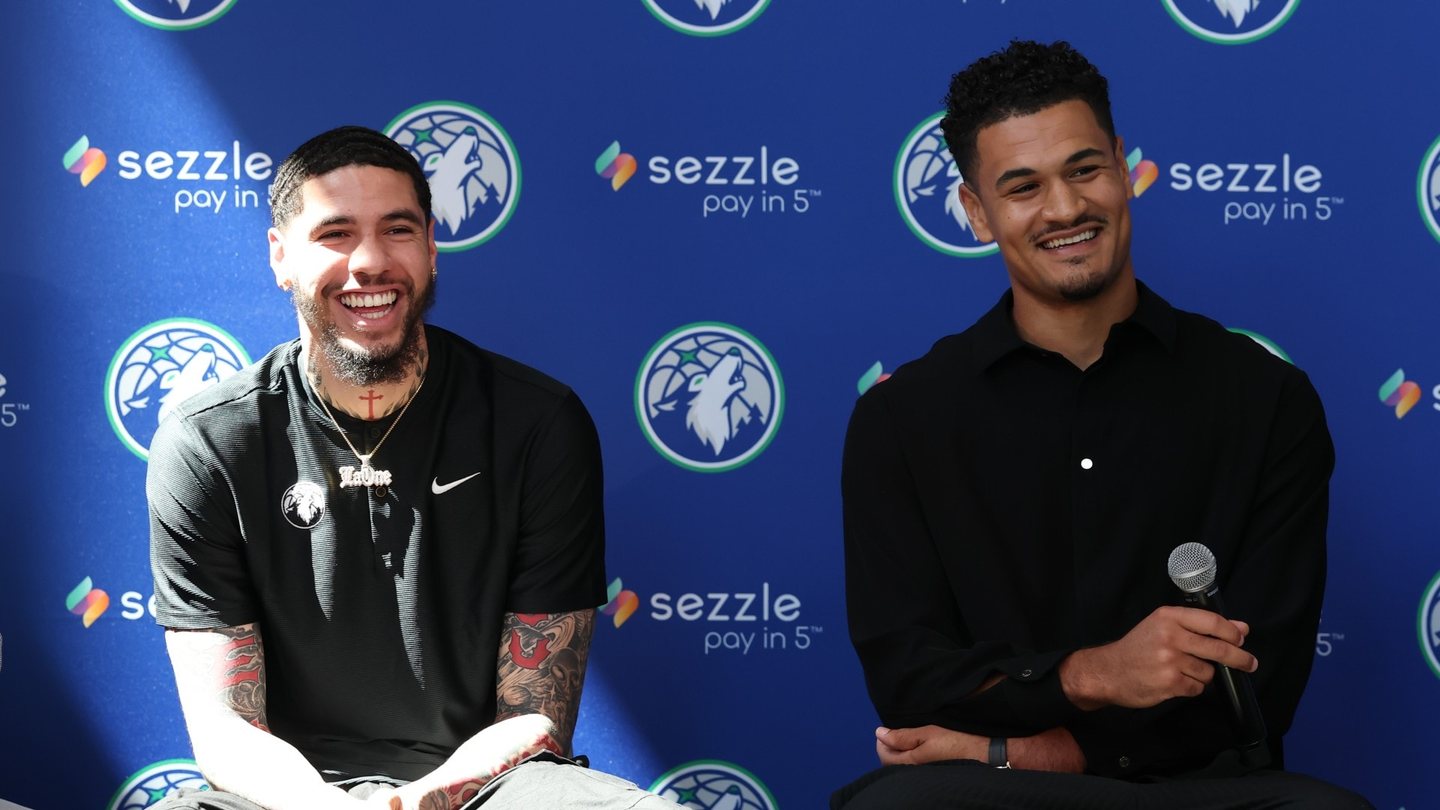
Naz Reid went to Charlotte in the LaMelo Ball deal, and Julius Randle went to Brooklyn in the same four-team trade, a move that cleared cap room. Ball replaces most of what the two of them did on offense. The rebounding and the trips to the free throw line are the holes Minnesota has to fill before the October 21 opener at Miami, per Basketball Reference’s schedule.
Here is what walked out the door. Per Basketball Reference, Randle and Reid played 4,617 of Minnesota’s 19,781 minutes last season, 23.3%. In those minutes they scored 2,713 of the team’s 9,676 points (28.0%) and grabbed 1,009 of its 3,615 rebounds (27.9%). They also took 619 of its 2,072 free throw attempts, 29.9%.
They produced more than their share of the minutes they played. Randle was the second-leading scorer behind Anthony Edwards, per NBA.com, and averaged 21.1 points a game.
What Ball covers
Ball covers the threes and most of the passing. Randle and Reid combined to make 271 threes (109 and 162). Ball made 272 for Charlotte in 72 games, shooting 36.8%, per Basketball Reference. One player replaces two in that column.
Passing is close. Randle (398) and Reid (170) had 568 assists between them. Ball had 514, at 7.1 a game. He’s a better passer than both, and the Wolves will also get to see what Edwards looks like with a point guard taking some ball handling, which I wrote about in Anthony Edwards giving LaMelo Ball the offense.
That’s the good news. Minnesota gets the shooting and the playmaking in one body, with 20.1 points a night on the side. It also gets a player who played 72 games last year after missing most of the time in earlier years: the NBA.com piece notes Ball played in only 43% of the games over a three-year stretch from 2022-25. Everything above assumes he’s on the floor.
What Ball doesn’t cover
Ball averaged 4.8 rebounds in 28 minutes. Randle and Reid combined for 1,009 in 4,617 minutes, about 0.22 a minute. Ball’s rate is about 0.17. The glass is not his job.
The free throw line is the quieter loss. Randle alone went 398-for-496 there, 80.2%, and the pair took 619 trips. Ball took 2.5 free throws a game for Charlotte. Jonathan Kuminga took 3.4 a game in 23.1 minutes across Golden State and Atlanta, per Basketball Reference. Those two can get some of it back, but nobody on the roster is a straight swap for Randle’s 6.3 attempts a night. I made the case in the Wolves’ free throw gap piece that those points were already hard to find. They just got harder.
The blocks matter less. Reid had 78 and Randle 18, out of the team’s 476, and Rudy Gobert had 124 on his own. What changes is the second big on the floor. Gobert, Randle and Reid soaked up 6,997 minutes last season, 35.4% of everything, and the first two were starters.
Who takes the minutes
Kuminga is the first answer. He’s at 5.6 rebounds in 23.1 minutes, a rate of about 0.24 a minute, a shade better than the pair he’s partly replacing. I think he’s the right starter, and I expect him to get most of the minutes Randle played at the four.
Joan Beringer is the second. He played 314 minutes as a rookie and pulled down 92 rebounds, 45 of them offensive, about 0.29 a minute in a tiny sample. His problem is that he fouls, and if he can’t stay on the floor, the 4,617 minutes land on Gobert and Kuminga. Gobert is 34.
Trey Lyles and whoever wins the last roster spot (I’d take Drew Timme) are the depth. None of them is Reid, who made 36.2% of his threes on 5.8 attempts a game. You can see every contract and the full depth chart in our 2026-27 roster guide.
The price, in context
The trade has a case. Minnesota sent Charlotte a 2033 unprotected first-round pick, three first-round swaps and three second-rounders along with Reid, per the NBA.com trade report, and the NBA.com introduction story adds that the Randle part of the trade opened the cap room to re-sign Ayo Dosunmu. Tim Connelly said at Ball’s introduction, “we have none for the next 10 years,” about first-round picks.
My read is that Ball is a net win on offense and a loss on the boards. Rebounding and the free throw line are what the roster has no full answer for yet.
What I’d watch
First, Minnesota’s offensive rebounding. Randle and Reid grabbed 222 of the team’s 907 offensive boards, 24.5%. If the number drops with Gobert and Beringer on the floor, the second-chance points go with it.
Second, the free throw rate in the first 10 games. If Kuminga isn’t getting to the line at his 2025-26 pace, the lost trips are real.
Third, how many minutes Ball plays. He’s the one who covers the threes and the passing, so everything about the replacement math depends on him playing 70 games, not 43% of them.