
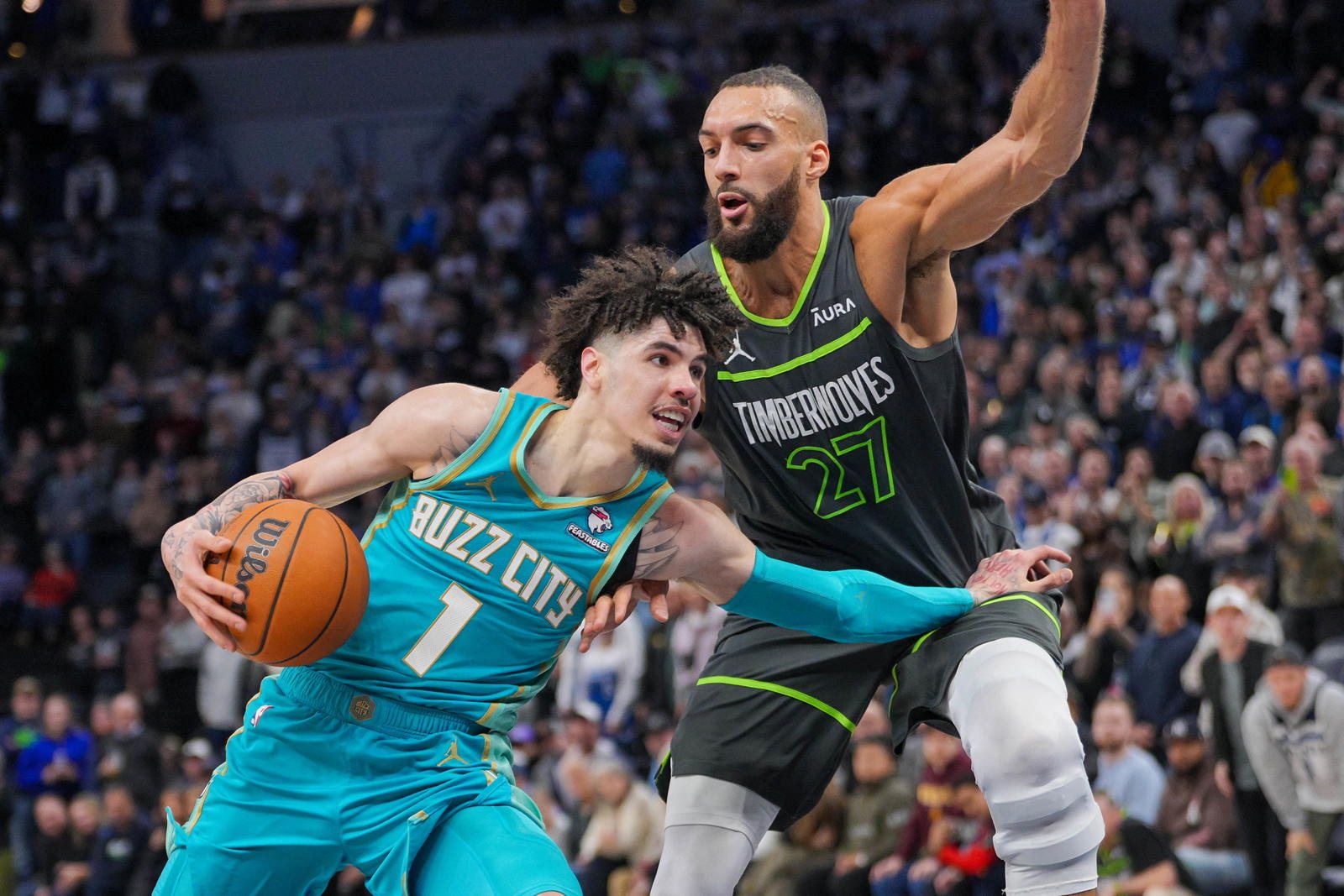
Rudy Gobert didn’t hide what he expects from his new point guard. “I think LaMelo is one of the best passers in this league, one of the best creators, especially for big men,” he said at media day on September 28.
He’s right, and I think it’s the most underrated part of the Ball trade. Everyone is talking about what Ball does for Anthony Edwards. What he does for Gobert might be the easier win. Gobert’s offense got smaller last season, and less of it came from a teammate setting him up. Ball is the lob passer Chris Finch says the Wolves never had for him, and the numbers say there’s a lot of room to grow.
Gobert’s offense shrank last season
Start with the volume. Gobert averaged 10.9 points on 6.5 shots a game in 2025-26, per Basketball Reference. Both were his lowest since 2015-16, his third season in the league.
He wasn’t bad. He shot 68.2% from the field, his best mark in four years in Minnesota. He also dunked 189 times, tied with Jalen Duren for third in the NBA behind Evan Mobley (207) and Amen Thompson (201), per Basketball Reference’s shooting data. The finishing is still there. The touches aren’t.
And a lot of what he did get, he got himself. Gobert pulled down 3.9 offensive rebounds a game last season, tied for the most of his career. That’s a center living on second chances, not on plays run for him.
Fewer of his baskets came off a pass
This is the number that sold me. Basketball Reference tracks what share of a player’s made two-pointers were assisted. For Gobert last season, it was 65.7%. That’s his lowest since 2015-16.
Here’s the trend, Utah to Minnesota:
| Season | Team | Made 2s assisted | Dunks |
|---|---|---|---|
| 2018-19 | Utah | 73.5% | 306 |
| 2020-21 | Utah | 76.7% | 231 |
| 2022-23 | Minnesota | 74.4% | 200 |
| 2023-24 | Minnesota | 68.5% | 248 |
| 2024-25 | Minnesota | 70.7% | 225 |
| 2025-26 | Minnesota | 65.7% | 189 |
In his last six seasons in Utah, that share never dropped below 72%. In 2018-19 he dunked 306 times. Gobert has always been a better finisher than a creator, so when the passes dry up, so does his offense.
Finch already said it out loud
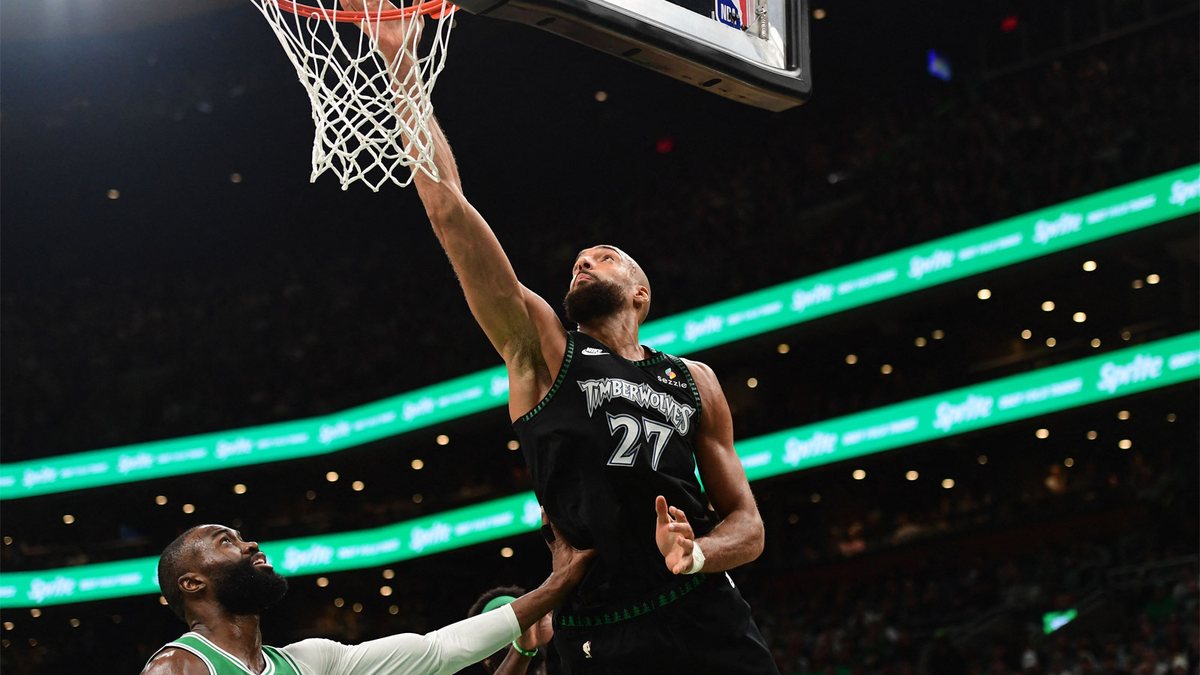
Finch said as much in August. On the Road Trippin’ show, he said the Wolves had never really been able to use Gobert as a lob threat because they hadn’t had that kind of passer with the ball in his hands.
The roster backs him up. Julius Randle, a power forward, led the Wolves in assists last season at 5.0 a game, per Basketball Reference. Edwards averaged 3.7 while playing a lot of point guard. As a team, Minnesota averaged 26.1 assists, 16th in the league.
Ball averaged 7.1 assists in just 28.0 minutes a night for Charlotte. Basketball Reference credits him with 1,263 points generated by his assists last season. Charlotte finished 44-38 with the league’s fifth-best offensive rating, 119.4 points per 100 possessions, while Minnesota was 12th at 116.8.
There’s no one on last year’s Wolves roster who looks like that with the ball in his hands. That’s the whole point.
Where the lobs will come from
Don’t expect this to be a fast-break thing. Charlotte’s pace last season, 96.8 possessions per 48 minutes, was among the five slowest in the league. Minnesota played at 100.5, inside the top 10. Ball does his damage in the half court, out of the pick-and-roll.
That’s where Gobert fits. Ball took 10.3 threes a game in Charlotte and made 36.8% of them, so defenders have to chase him over the screen. Once they do, Gobert is rolling into open space with a passer who can throw it over the top. Edwards spotting up in the corner, which is where he wants to be now, keeps one more defender from helping.
The catch is the fourth spot. If Jonathan Kuminga starts, as I argued he should in my case for Kuminga over Ayo Dosunmu, the defender on him can sag into the paint and sit in the lob lane. Kuminga’s shooting will decide how much room Ball and Gobert really get.
What could go wrong
Lobs are risky passes. Ball averaged 2.8 turnovers last season, and 114 of his 202 turnovers were bad passes, per Basketball Reference’s play-by-play data. Some of those will turn into easy dunks for Gobert. Some will turn into run-outs the other way.
The backup center problem doesn’t go away either. When Gobert sits, the next center up is Joan Beringer, who played 7.9 minutes a night as a rookie. That’s the hole I flagged in the five questions for media day, and Ball can’t pass his way around it.
There’s money in this too. Gobert is 34, makes $36.5 million this season and holds a player option for next year. He becomes eligible for an extension of up to three years and $165.6 million on October 24, per ESPN’s Bobby Marks. The full numbers are in the Wolves’ 2026-27 roster and contract guide. A bigger offensive season helps his case and the team’s.
What to watch
The preseason opens Monday, October 5, at Milwaukee. I’m watching one thing in the Ball and Gobert minutes: how often Gobert’s baskets come straight off Ball’s pass.
If that assisted share climbs back above 70%, where it sat in each of his last six Utah seasons, Minnesota gets more offense from a player it’s already paying $36.5 million without adding anyone. That’s the cheapest upgrade the Wolves made this summer, and it starts with Ball throwing it up.