
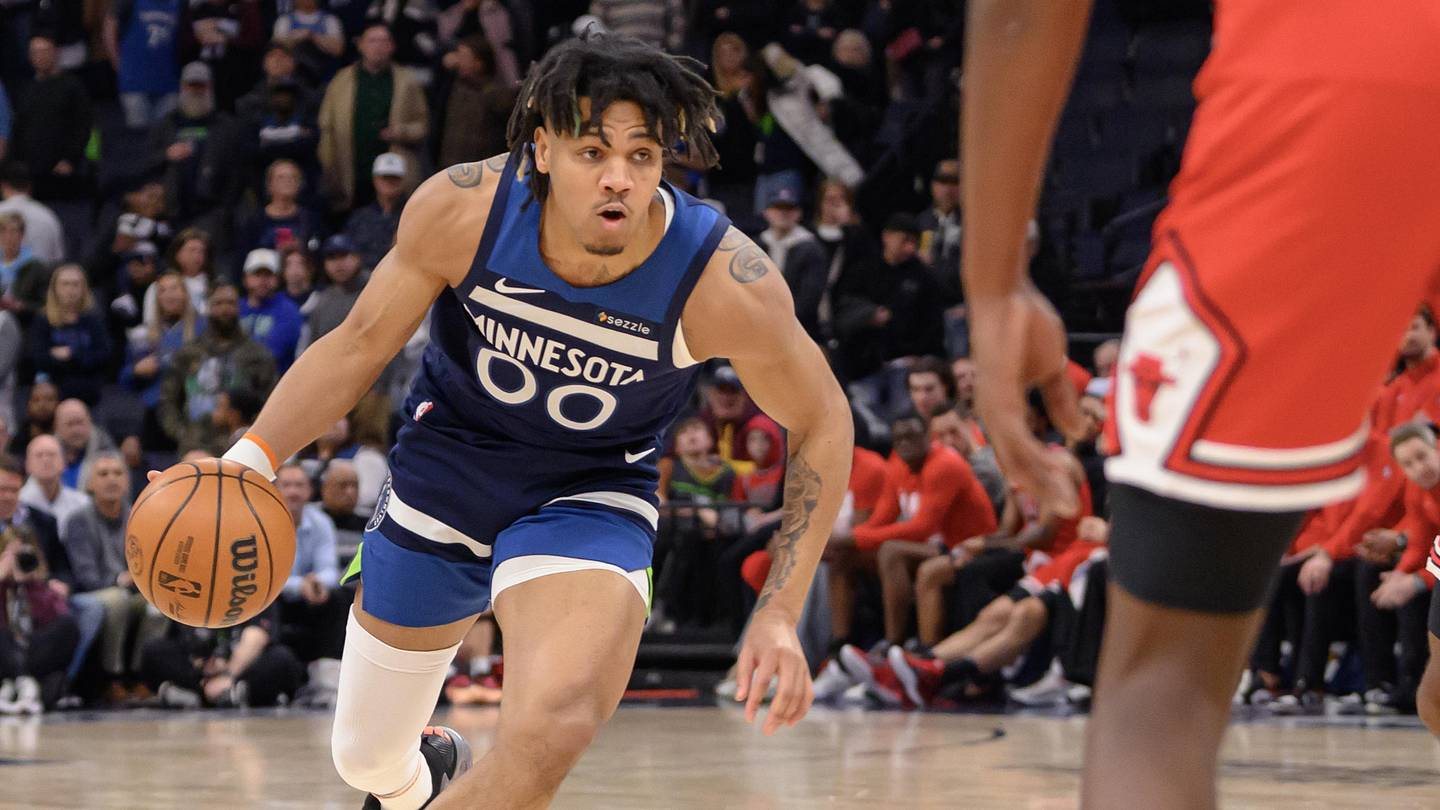
Terrence Shannon Jr. should be the first wing Chris Finch calls off the bench this season, ahead of Jaylen Clark. The Wolves are about to put the ball in the hands of Anthony Edwards and LaMelo Ball, and the player who spaces the floor for them is worth more than the player with the better reputation on defense.
Clark gets the matchup assignments. Shannon should get the default minutes.
The shooting gap is the whole argument
Shannon made 40.8% of his threes last season on 1.8 attempts a game across 43 appearances, according to Basketball Reference. He also made 80.0% of his free throws. Those are small samples, because he played 12.5 minutes a night, but they point the same direction as the year before, when he shot 35.5% from three.
Clark went the other way. After making 43.1% of his threes in 2024-25, he made 32.7% on 1.5 attempts last season, per Basketball Reference. His free throw percentage was 65.7%. In 68 games he averaged 13.1 minutes and 4.0 points. A wing who is on the floor to guard needs to make defenders pay when the ball swings to him, and last year Clark didn’t.
This matters more now than it did a year ago. The roster guide has Ball starting next to Edwards, and the whole idea is that two ball-dominant guards need other players who punish help defense. A bench wing who can’t make the catch-and-shoot three lets a defender sag into the lane.
The defensive case for Clark is real, and it slipped
Clark’s defensive reputation was earned. Basketball Reference put his defensive box plus-minus at 2.7 in 2024-25. Last season that fell to 0.7, with an overall box plus-minus of minus 2.4.
Box plus-minus is an estimate built from the box score; I wouldn’t hang a verdict on it. But the direction matters.
Shannon’s box plus-minus was worse: minus 3.6 overall and minus 1.1 on defense. The case for Shannon is his offense, which is the thing the second unit lacks, and Clark’s defense can be called on in specific games instead of all 82.
What the preseason showed
Finch has shown a lean. Against Detroit, the closest thing the Wolves had to a dress rehearsal, Shannon played 18 minutes and Clark played eight, as laid out in our piece on Isaiah Evans and the Wolves’ rotation. In the Heat game, Shannon started and scored 19 points on 8-of-16 shooting with three threes, six rebounds and four assists, NBC Sports reported.
That Heat game was an exhibition, so 19 points proves little. The Detroit minutes are the more useful sign. When Finch was setting the rotation he would actually use, Shannon got more than twice Clark’s run.
The playoff warning
The counterargument is fair. In last spring’s playoffs Shannon played 22.6 minutes over nine games and averaged 11.8 points, but he made only 25.0% of his threes on 3.6 attempts, according to Basketball Reference. That’s a bigger role than he’d ever had, and the shooting dipped when the attempts rose.
It’s a caution about volume.
The playoff line had one more number worth keeping. He made 91.7% of his free throws in those nine games, per Basketball Reference, which fits the 80.0% he shot in the regular season. A player who gets to the line and makes his shots there is harder to take off the floor than a pure spot-up shooter, even in a month when the threes aren’t falling.
The money doesn’t force the decision
Neither contract picks a winner. Clark is on a three-year deal at $3.1 million this season, and Shannon makes $2.8 million, rising to $5.1 million next year, according to the roster guide’s contract table. Both are cheap, and neither number guarantees a spot. The minutes get decided on the floor, and Finch can change his mind in January without a contract getting in the way.
Cody Williams isn’t the answer yet
The third name in this conversation is Cody Williams, the 6-8 wing who played for Utah last season. His 2025-26 year there was a rough one: 24.3 minutes, 8.8 points and 21.4% from three on 2.0 attempts, with a box plus-minus of minus 5.5, per Basketball Reference. He’s 21, and on shooting alone he can’t be the guy who steadies a second unit right now.
How I’d use all three
Start the bench rotation with Shannon. Let him spell Edwards, run alongside Ayo Dosunmu in the second unit (my Kuminga starting piece argues Dosunmu is more valuable off the bench), and keep the floor spaced for the first drive of every possession.
Keep Clark as the call for a specific night. If the opponent has a wing who is carrying the offense, as Miami might with Giannis Antetokounmpo in Wednesday’s opener, Finch can send Clark at him for six or eight minutes and bring Shannon back after.
Clark’s three-point drop last year is the number to watch. If he gets back toward the 43.1% he shot in 2024-25, I’ll change my mind. Until he does, Shannon is the wing I’d give the minutes to.