
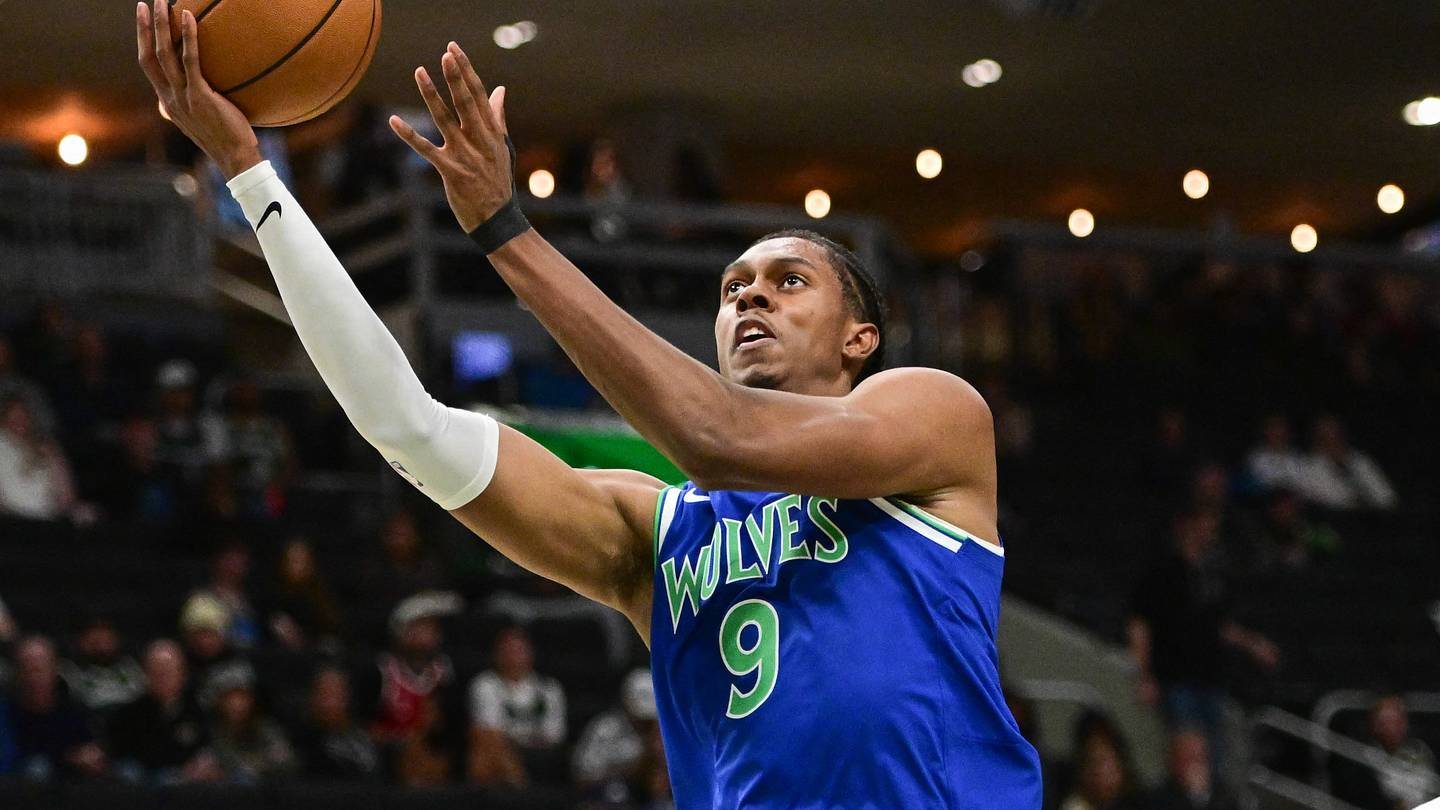
Cody Williams should spend his next Timberwolves shift finding space behind a defender who is watching the ball. I want Minnesota to make cutting and quick passing the center of his audition, instead of asking him to prove he can manufacture a scoring run.
There is an opening on Monday, November 2. Dane Moore reported before the Milwaukee game that Chris Finch said Williams would get minutes with Terrence Shannon Jr. and Anthony Edwards absent. My preference is to give Williams a specific offensive assignment that can survive beyond one night of available playing time.
His Utah improvement points inside the arc
The strongest argument for that assignment is on Williams’ Basketball Reference page. He improved from 39.3% on two-pointers as a rookie to 55.6% last season in Utah. The underlying totals went from 48-for-122 to 210-for-378. His three-point shooting last season was 28-for-131, or 21.4%.
Those numbers make me more interested in the next opening near the basket than the next attempt to turn him into a floor spacer. They also leave a coaching question that a shooting percentage cannot answer: how should Minnesota get him those opportunities?
I’d start by having him move when his defender turns toward the ball. If a teammate draws help, Williams should look for a route into the space that defender has left. Catching on the move gives him a chance to finish a possession without first having to beat a set opponent off the dribble.
Give him rules for when to move
A cutter can help an offense or get directly in its way. I wouldn’t send Williams toward the rim on every drive. Minnesota should give him a clear read: move behind a defender who commits to helping, and keep the lane clear when the ballhandler already has a path.
I’d also use Williams as an occasional screener away from the ball. Setting a screen gives his defender another decision and gives Williams a reason to move with purpose afterward. He can open toward the ball, slip into a gap or clear out if the first option is covered.
The aim is to give him something useful to do before the pass arrives. Standing in a corner asks the jumper to carry much of his offensive value. Moving at the right moment gives him another way into a possession, even if the defense remains willing to concede the outside shot.
There is a cost to that movement. A mistimed cut can bring another body toward Rudy Gobert or Joan Beringer. I’d judge Williams on recognizing the occupied space as carefully as I would judge the finish. The Wolves roster and depth chart shows why his assignment has to fit alongside Minnesota’s other frontcourt options.
The next pass belongs in the audition
Williams had 137 assists against 73 turnovers last season, according to Basketball Reference. He also played 67 games and started 41. That is enough experience for me to ask him to make a useful decision after the first scoring chance disappears.
If he catches near the lane and the center steps toward him, I want the easy pass to the teammate that help has exposed. If the lane closes before the catch, I want him to move the ball along and change positions. There is no need to turn every touch into a test of his handle.
I’d pair that assignment with a guard responsible for organizing the possession. Our argument for Bones Hyland to run the reserve offense addresses that separate job. Williams can help a creator by arriving in a useful place and deciding quickly, without becoming the player responsible for starting every action.
That division would also make the evaluation clearer. A missed layup after a well-timed cut and a possession spent dribbling into traffic call for different coaching responses. I’d want the next substitution to reflect the decision as well as the result.
A defined shift beats a scoring demand
Through October 31, Basketball Reference lists Williams with four regular-season appearances, 13 rounded total minutes and one field-goal attempt for Minnesota. There is little reason to build an offensive verdict around that start.
I would give him a planned stint with the same instructions each time. Defend his assignment, find the opening when help moves and make the next pass when a finish isn’t available. A short appearance becomes more informative when the player knows which decisions the coach wants repeated.
Moore’s Monday post also carried Finch’s assessment of Williams: “Been a pleasant surprise all the way around.” That is encouraging. I’d turn the encouragement into an offensive job he can practice and recognize during a game.
Williams doesn’t need to answer every question about his future against Milwaukee. He needs to give Finch a reason to use him when the rotation fills back out. I would start that case with a well-timed cut and an immediate decision after the catch.