
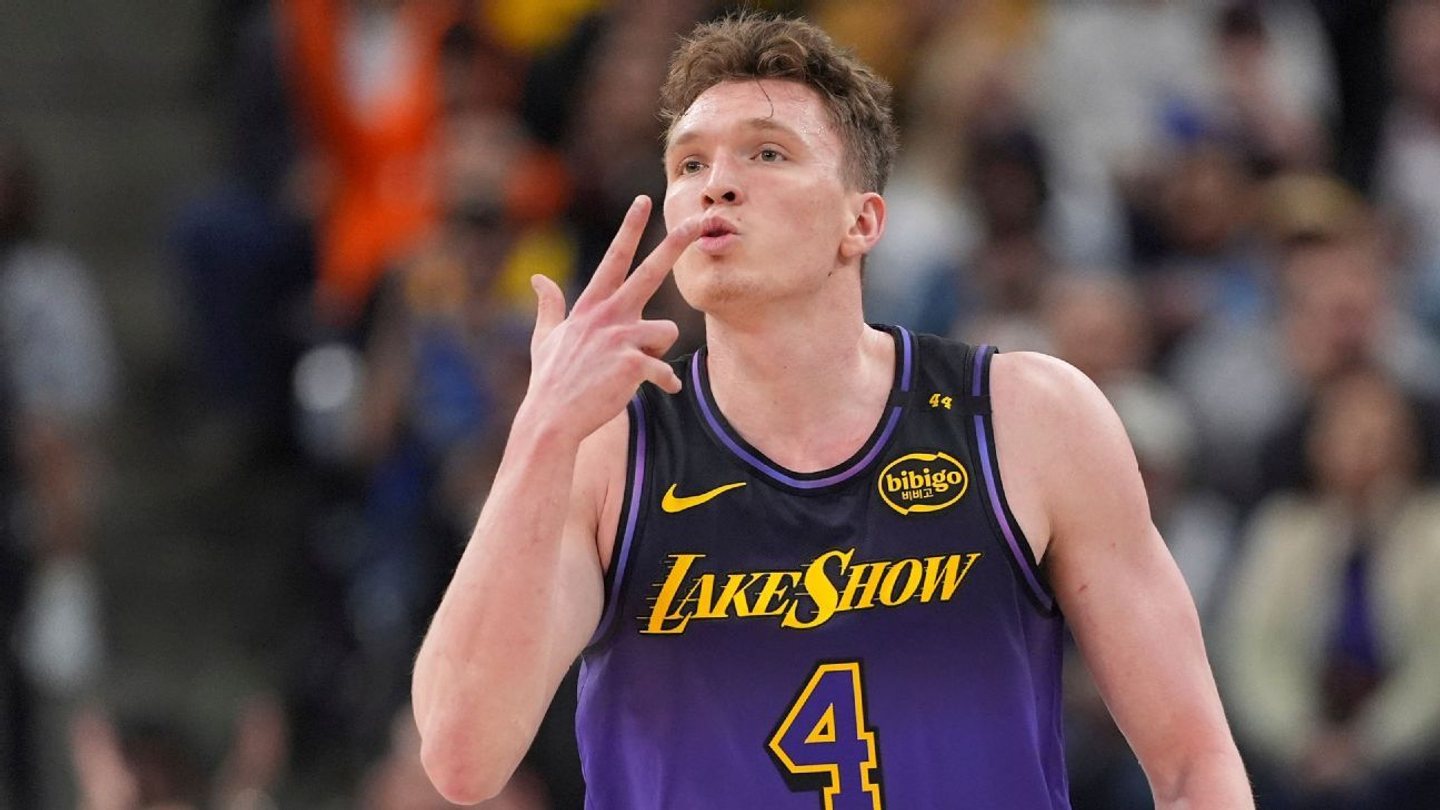
Dalton Knecht is headed to New York, and I still want the Timberwolves shopping for the same skill. A shooter worth developing is a sensible use of Minnesota’s open two-way spot. Missing this particular player should not change that plan.
On Friday, October 23, Shams Charania reported that Knecht’s agents confirmed his agreement with the Knicks. Dave McMenamin’s ESPN story also identifies Minnesota among the teams that expressed interest, citing Charania’s sources. I like the Wolves looking. Knecht was worth an audition, with a nightly role still to be earned.
The rookie season made Knecht worth a look
Knecht’s appeal starts with a full season of useful outside shooting. According to Basketball Reference, he made 128 of 340 threes as a Lakers rookie in 2024-25, good for 37.6%. He averaged 9.1 points in 19.2 minutes across 78 games.
That is enough shooting to justify another team’s attention. A player who has already made that many NBA threes offers a different starting point from a prospect whose jumper remains entirely a projection. The question becomes whether a new staff can help him sustain the skill while building the rest of his game around it.
For Minnesota, I would want a simple assignment for that kind of addition: be ready when the ball arrives, shoot the open three and keep the possession moving when the shot isn’t there. An audition should begin with something the player has shown he can do.
The Wolves roster and depth chart gives the broader context for building around Anthony Edwards and LaMelo Ball. My preference for the next developmental signing would be someone who can finish a possession those guards create, rather than someone who needs his own sequence of dribbles to get comfortable.
The second season should temper expectations
Knecht’s Lakers follow-up was much less convincing. Basketball Reference lists 4.2 points and 10.2 minutes per game over 54 appearances in 2025-26. He made 38 of 111 threes, or 34.2%.
Those numbers should lower the expectations attached to any fresh start. The rookie shooting is part of the evaluation, but so is a season in which both his playing time and accuracy fell. I would start by testing the jumper again and make a nightly job depend on how he plays now.
The attempt totals also deserve attention. Last season’s outside shooting came on less than a third of his rookie three-point volume. Across the two regular seasons, he made 166 of 451, a combined 36.8%, per Basketball Reference. The career figure gives a more encouraging picture than last year’s percentage alone, without erasing the decline.
A change of teams offers a new opportunity. The next candidate would still need to show that his jumper holds up when a defender rushes him, and that he can stay useful when the first shot misses. That is the test I would set in Minnesota.
The open spot lets Minnesota be specific
The Wolves released Enrique Freeman on October 17. Zyon Pullin and Rocco Zikarsky occupy the two-way places on Minnesota’s official October 19 roster, leaving one of the three permitted spots open. Those contracts sit outside the standard roster.
That leaves a place to evaluate another player without first removing someone on a standard deal. I would use it to make a focused bet on shooting. There is no need to demand that the next signing solve every bench problem before he has practiced with the team.
I would use Iowa to test more than an uncontested catch. Have the prospect sprint into a handoff, square his feet and shoot before the defender recovers. Then repeat the action with the defender taking away the jumper. Can he deliver a quick pass and relocate for another attempt? That would tell me more about his fit than letting him dribble through a possession until he finds a shot he likes.
If that work produces a more dependable shooter, Minnesota has made progress even while his NBA minutes remain scarce. I would want the staff to see the same decisions hold up across different defensive coverages before expanding his assignment. A developmental signing should earn each addition to his job.
Keep the competition open for the players already here
Terrence Shannon Jr., Jaylen Clark and Isaiah Evans all appear on Minnesota’s official opening roster. My earlier case for Shannon as the first wing off the bench concerns the minutes Finch should distribute now. This search should concern who might earn a useful job later.
The same distinction applies to Evans’ preseason scoring and rotation case. An appealing shooting night should earn more evaluation. It shouldn’t end the competition, whether the shooter was drafted by Minnesota or arrives after another team cuts him.
I would ask the next prospect to shoot promptly against a closeout, make the next pass when crowded and stay involved defensively after a miss. Those are the possessions I want a developmental plan to address. An attractive percentage by itself would leave too much of the job unexplained.
Knecht’s agreement takes one candidate away. It leaves Minnesota with the same useful question: which available shooter is worth spending time on? Keep the spot available until the answer is convincing, then give that player a job he can actually learn.