
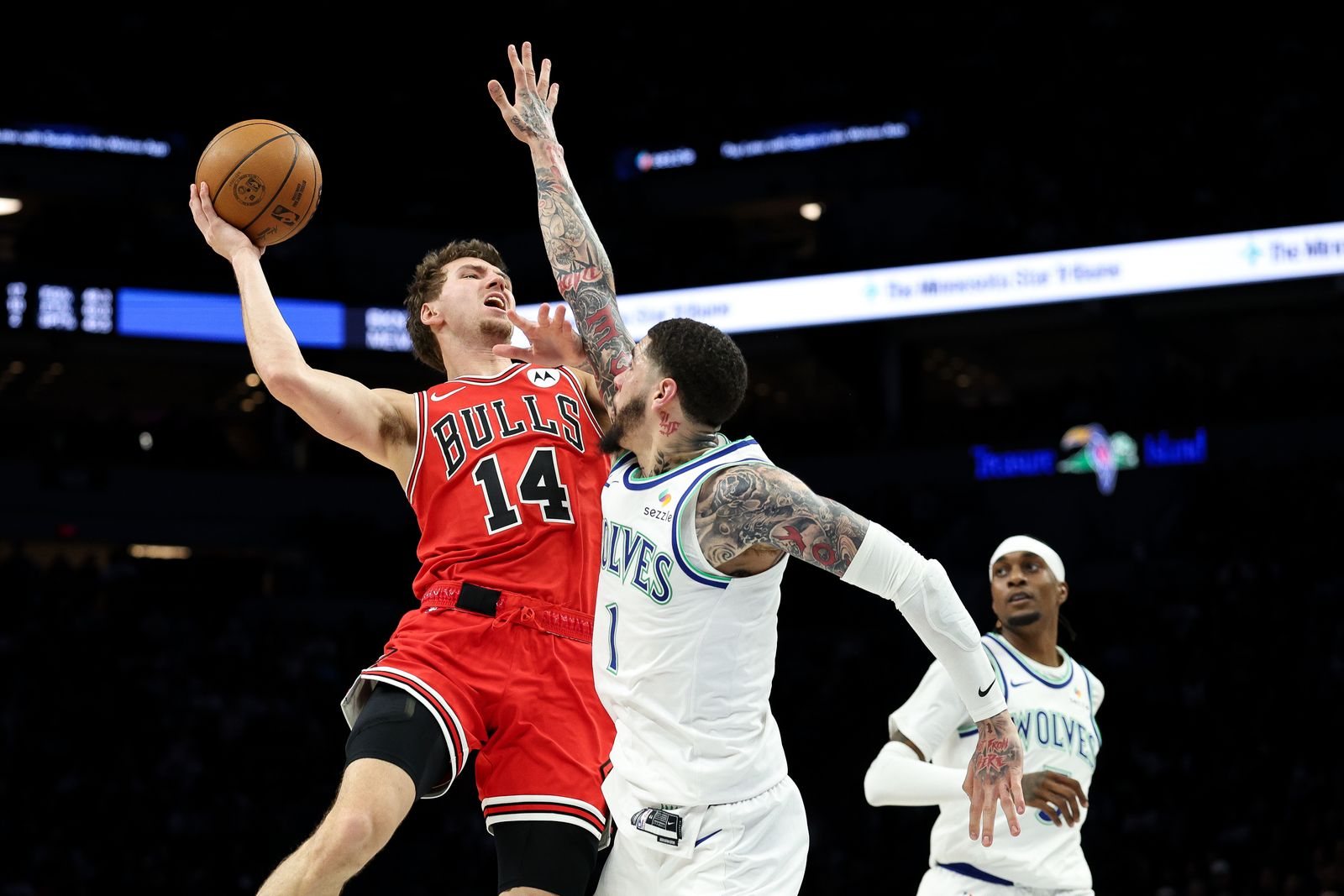
Chicago’s bench scored 50 points in Saturday’s 117-106 win over the Timberwolves. Buddy Hield, Tre Jones and Patrick Williams supplied 46 of them. Minnesota has plenty to fix after this loss, but I want Chris Finch to start with who defends opposing reserves while his own shooters are on the floor.
My preference is to stagger Jaden McDaniels or Ayo Dosunmu into those minutes and give that starter the most dangerous perimeter assignment. Keep Bones Hyland’s shooting available. Keep testing Trey Lyles as a floor spacer. Make the defensive support around them a priority before deciding the bench needs less offense.
Chicago’s reserves posed different problems
The ESPN box score shows Hield scoring 16 points on 6-of-10 shooting, including 4-of-6 from three. Jones also scored 16, making seven of nine shots and his only three-point attempt. Williams added 14 on 5-of-9 shooting and went 2-of-4 from outside.
Adding ESPN’s player totals, the trio made 18 of 28 shots, including seven of 11 threes. Minnesota needed answers for both the outside shooting and the scoring inside the arc.
I’d organize the matchups around that distinction. Against a shooter getting Hield’s results, I want a defender assigned to stay attached through the action, with less temptation to help away from him. Against Jones, I want the first defender to make the drive uncomfortable before the big has to decide whether to leave his own man.
I’d plan for both jobs in the next rotation. Chasing Hield around a screen and containing Jones’ first step ask different things of the defense. I’d want the substitutions to reflect those different assignments.
The Wolves’ earlier two-point defensive warning belongs in this conversation. A hot shooter can make a reasonable defensive night look worse. A rotation still needs a way to make scoring inside the arc difficult when that shooter pulls attention outside.
Bench points don’t identify the guilty lineup
Chicago’s reserves outscored Minnesota’s 50-33, calculated by adding the bench player rows in ESPN’s box score. That is a useful description of who scored. It doesn’t establish that the Bulls scored those points against five Minnesota substitutes.
The practical question is how Finch arranges them so that an opposing reserve scorer faces a difficult matchup even after Minnesota makes substitutions.
ESPN lists Hyland at minus-13 in 21 minutes and Lyles at minus-16 in 19. Those individual plus-minus figures describe the score while each played. They don’t isolate his defense, and they don’t tell us the result of the Hyland-Lyles pairing by itself.
Still, those minutes deserve attention. I’d begin by reviewing which defender had the toughest assignment in each stint, then decide whether a starter’s substitution pattern should change. Cutting a shooter is an easy response to a bad margin. Building a group that can defend while keeping that shooter useful takes more care.
Hyland supplied something worth protecting
Hyland scored 12 points and made three of five threes, per ESPN. Lyles scored five, missing all three of his outside attempts. Their shooting nights were different. I’d keep evaluating their roles separately.
Hyland’s makes are the clearest reason to preserve his opportunities. If Minnesota can put a stronger defensive assignment next to him, it can keep the threat of his jumper without asking every possession to become a scoring contest.
We’ve made the case for Hyland and Lyles to share bench minutes. I still like the offensive idea. Saturday makes me more interested in who fills the other perimeter spots around that combination. My preferred first experiment would include McDaniels, with a clear assignment to handle the opponent’s main perimeter threat.
That requires a choice elsewhere in the game. McDaniels played 37 minutes against Chicago, per ESPN. I want to redistribute his time, rather than solve every bench problem by asking him to play longer. The full Wolves depth chart lays out the players Finch has to fit around that decision.
Shannon’s offense needs cleaner possessions too
Terrence Shannon Jr. gave Minnesota 14 points on 6-of-9 shooting and six rebounds, per ESPN. He also committed four turnovers. Hyland had two turnovers, so the pair accounted for six between them.
That gives Finch another specific job for his reserve scorers. I want Shannon attacking a defense that has already shifted, with a simple finish or pass available. I’d rather use a starter to help organize those possessions than ask Shannon to create a difficult advantage every time he touches the ball.
The defensive proposal and the offensive one can fit in the same substitution plan. Dosunmu would be my alternative to McDaniels when Finch wants another player to begin an action. The priority would remain keeping a trusted starter involved with the reserves, with his job decided before the group takes the floor.
Tyler Mason’s AP recap, carried by ESPN, has Portland visiting on Monday. My test for Finch is the first stretch when his bench scorers enter: give them a starter with a clear defensive responsibility, and keep enough shooting around him to make the other team work at both ends.